Mandatory Safety Equipment
Under Transport Canada's Small Vessel Regulations, paddlers on Canadian waterways are required to carry specific safety equipment regardless of the type of water. For vessels under 6 metres in length (which covers most canoes and touring kayaks), this includes a lifejacket or PFD for each person on board, a sound-signalling device, a buoyant heaving line of at least 15 m, a bailer or manual pump, and navigation lights if operating in reduced visibility or at night.
Requirements for vessels in specific zones (such as certain coastal areas or designated boating areas) may impose additional requirements. The current version of the regulations should be consulted at tc.gc.ca.
Lifejacket vs. PFD: Transport Canada distinguishes between lifejackets (which turn an unconscious wearer face-up) and personal flotation devices (PFDs). On river tours, a PFD designed for paddling — with a high armhole cut, foam panels that do not interfere with paddle stroke, and a snug fit — is generally more suitable than a traditional bulky lifejacket. It must still meet the required buoyancy rating.
Reading River Current
River current is not uniform. Velocity varies across the channel cross-section and is influenced by channel shape, gradient, obstacles, and discharge volume. Effective current reading allows paddlers to identify safe lines before committing to them.
V-shaped Surface Patterns
A downstream V shape on the water surface indicates a clear, deeper channel between two obstructions. This is the typical "safe line" marker used to navigate around rocks in Class I–II rapids. An upstream V indicates a submerged obstacle with current deflecting around it — paddlers should avoid these.
Eddies
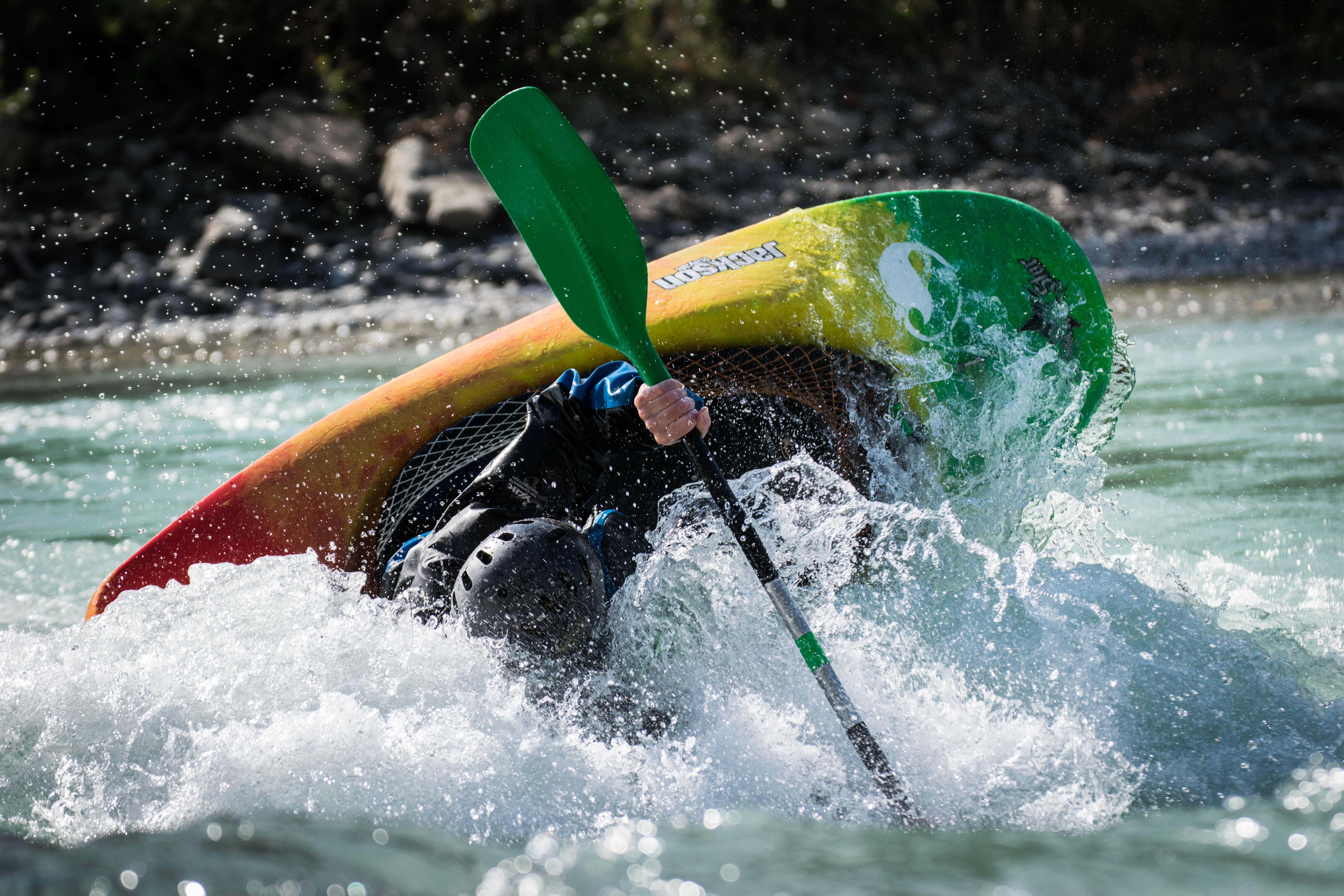
An eddy is a zone of calm or upstream-flowing water behind an obstacle (a rock, a point of land, a pier). Eddies are used as rest points, scouting positions, and recovery spots after a rapid. The boundary between the main downstream current and the eddy is called the eddy line. Crossing the eddy line requires a deliberate edge and sweep stroke combination; failing to account for this transition commonly causes capsizes for paddlers new to moving water.
Hydraulics and Holes
When water flows over a submerged feature and drops into a depression, it creates a recirculating feature called a hydraulic or hole. The downstream face of the hole has a surface current flowing back toward the feature, which can trap swimmers and boats. Hydraulics form below low-head dams, ledges, and large submerged rocks. They are extremely dangerous regardless of apparent size and should be portaged around in all cases on touring trips.

Scouting
Paddlers should scout any rapid or river section they cannot see completely from an upstream position. Scouting involves exiting the boat above the feature, walking downstream along the bank to view the full rapid, identifying hazards, selecting a line, and identifying the best self-rescue and group-rescue positions for the group. If a safe line cannot be identified, the section should be portaged.
The decision to scout should be made conservatively. In a loaded canoe or touring kayak, a capsize in fast water with gear aboard creates significantly more rescue complexity than in an unladen day boat.
Cold Water and Immersion Risk
Water temperature on Canadian rivers varies significantly by season and watershed. In spring on rivers fed by snowmelt, water temperatures below 10°C are common even when air temperatures are warm. Cold shock — an involuntary gasp reflex and hyperventilation triggered by sudden immersion in cold water — can incapacitate a swimmer within seconds, regardless of swimming ability.
Paddlers on cold water should wear thermal protection. A wetsuit provides insulation while wet; a drysuit provides a waterproof barrier. The appropriate choice depends on water temperature, air temperature, distance from shore, and trip duration. As a general reference, the sum of air temperature (°C) and water temperature (°C) below 120 is often cited as a threshold where thermal protection should be worn, though this is a rough guideline rather than a precise standard.
Self-Rescue: Wet Exit and Swimmer Position
Following a capsize on moving water, the standard swimmer position is on the back, feet downstream, feet at the surface, and arms out to the sides for stability. This orientation allows feet to absorb the impact of submerged rocks while keeping the head out of the water. Fighting the current by trying to swim directly to shore is generally ineffective and exhausting; angling the body to use the current's energy to move toward an eddy or the bank is more efficient.
In a kayak, the wet exit sequence should be practiced in a controlled pool or calm water environment before any river trip. Spray skirts that are difficult to release under pressure present a drowning risk.
Group Rescue: Throw Bag Technique
A throw bag — a bag containing a floating rope — is the standard group rescue tool on moving water. The rescuer holds the end of the rope, throws the bag to the swimmer (not the rope), and braces against a fixed position on shore while the swimmer swings into the bank on the current. Common errors include throwing the bag too short, throwing it past the swimmer without accounting for current, and failing to brace before the swimmer's weight loads the rope.
A 15 m throw bag is the standard minimum length. Rivers wider than 15 m may require relay rescues or two rescuers. A buoyant heaving line meeting the Transport Canada specification is functionally similar but bags throw more accurately due to the weighted pouch.
Low-Head Dams
Low-head dams — small weirs that appear relatively benign from upstream — create powerful hydraulic features that have caused drownings on rivers throughout Canada. They are often unmarked and may not appear on maps. Any artificial structure crossing a river that drops water over a horizontal weir should be treated as a mandatory portage. Paddlers should exit the water well upstream, carry around the entire feature, and re-enter below the turbulent zone downstream of the dam.
Pre-Trip Preparation
Before any river trip, paddlers should obtain current flow data from Water Survey of Canada at wateroffice.ec.gc.ca. Flow levels above a known high-water threshold significantly increase risk on any river. Local paddling clubs often maintain river-specific gauge readings and can provide context on what flow numbers mean for specific routes. Leave a detailed float plan with a responsible person who can initiate a search if the party does not report back by the expected time.
Key Hazard Summary
- Upstream V = submerged obstacle
- Downstream V = clear channel
- Eddies = rest/recovery zones
- Hydraulics = portage mandatory
- Low-head dams = portage mandatory
- Cold water = wear thermal protection